Skip to main content Skip to footer


You finally have $5,000 saved. Your emergency fund is solid. You know you should invest it. But every time you think about putting money in the stock market, your chest tightens. What if the market crashes? What if I lose it all? What if I’m missing something crucial?
So you wait. You research more. You watch videos. You open your phone to invest, then close it. Months pass. Your money sits in a savings account earning 0.01% while inflation silently erodes its value.
The barrier isn’t information. It’s mindset.
An investor mindset isn’t about having perfect knowledge or picking the right stocks. It’s about understanding how your brain tries to sabotage your wealth-building, and then systematically taking away its power to do so.
The Psychology of Investing: Why Your Brain Fights You
Your brain evolved to handle immediate threats, not long-term wealth-building. When you think about investing, your amygdala (your fear center) activates. It doesn’t see long-term growth—it sees risk of loss.
This is why research shows that self-directed investors earn an average of 1.7% less per year than the market—not because they lack intelligence, but because emotions drive their decisions.
Here are the psychological forces working against you:
Fear and Greed Cycles
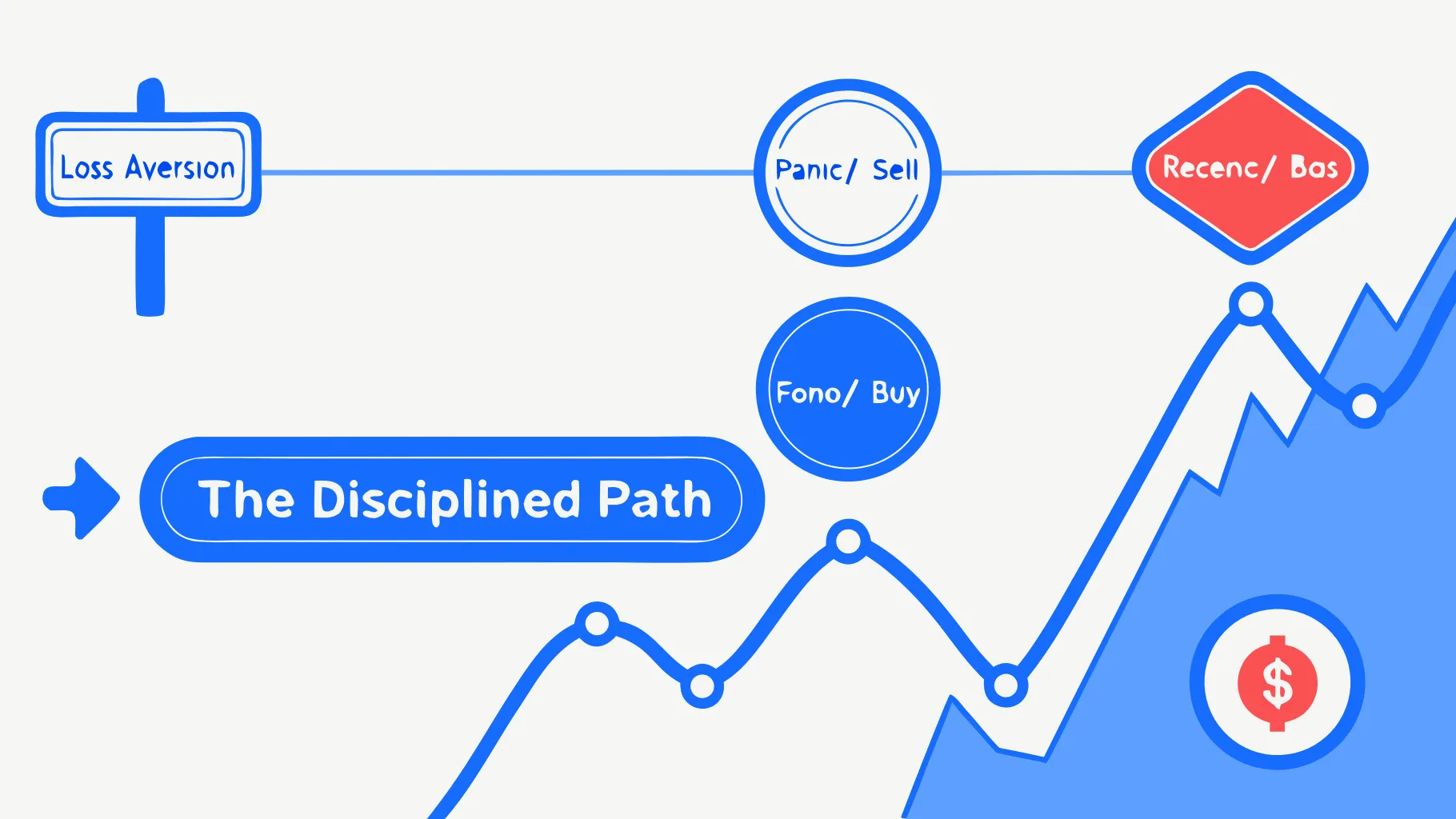
Fear shows up when the market drops. You see your portfolio down 10% and think “I should sell before it gets worse.” You sell at the worst time—the exact moment panic is highest—and lock in losses.
Then, six months later, the market recovers. You feel FOMO (fear of missing out) and rush back in—usually near market highs. You buy right before a correction. The cycle repeats.
Loss Aversion
You feel losses roughly twice as intensely as equivalent gains. Lose $1,000? It stings. Gain $1,000? It’s nice, but not nearly as satisfying. This makes investors overly cautious, avoiding reasonable investments because the possibility of loss feels bigger than the probability of gain.
Confirmation Bias
Once you decide you believe something about an investment, you hunt for information that confirms it and ignore information that contradicts it. Research shows 85% of investors accept opinions matching their existing beliefs and dismiss contradictory evidence. This creates dangerous overconfidence—investors convinced nothing can go wrong with their choices.
Recency Bias
You give too much weight to what just happened. Market dropped last week? You assume it’ll drop again. Boomed last month? You assume the rally continues. You extrapolate the recent past into the distant future.
Herd Behavior
You buy what’s hot because others are buying it, often at inflated prices. You sell when panic spreads, even if fundamentals haven’t changed. Social media and investment apps amplify this, showing other people’s wins and triggering dopamine-seeking behavior.
For Millennials and Gen Z especially, these biases are intensified by generational wounds. The 2008 financial crisis left a lasting mark on Millennials, and COVID-era volatility reinforced the message: markets are dangerous. Gen Z watched their parents’ anxiety and learned early that money is something to fear, not build with.
The result? Fear of investing often becomes the biggest barrier to wealth-building—paralyzing people who have the resources to invest but can’t overcome the psychological block.
The Investor Mindset: What Actually Works
Building an investor mindset isn’t about eliminating emotion. It’s about building systems that bypass emotion.
Here are the core principles:
1. Time in the Market Beats Timing the Market
This is the foundation. Markets move fast and unpredictably. Even professional investors consistently fail at market timing.
The data is overwhelming: over any 20-year period in modern history, major equity markets have always delivered positive returns—despite wars, recessions, crises, and corrections.
The investor mindset rejects the fantasy of buying at market lows and selling at highs. Instead, it focuses on staying invested consistently.
This shift alone transforms how you think:
- Instead of “When should I enter?” → “How do I stay committed?”
- Instead of “What if it crashes?” → “What does history show about recoveries?”
- Instead of “I need to be right” → “I need to be disciplined”
2. Dollar-Cost Averaging: Taking Emotions Out of the Equation

Dollar-cost averaging (DCA) is investing a fixed amount at regular intervals—like $500 monthly—regardless of market conditions.
Why this matters psychologically:
When you commit to DCA, you remove the decision-making moment. You don’t wake up asking “Is now a good time?” Your predetermined schedule answers that question.
You buy more shares when prices fall and fewer when prices rise, automatically averaging your cost down. But the real magic is emotional: DCA keeps you from panic selling or greed-driven buying because emotion becomes irrelevant.
Beginners specifically benefit because:
- You start small ($50-$100/month is fine) and gradually build confidence
- You experience market fluctuations over time and see that your strategy survives them
- You develop the disciplined habit that separates wealth-builders from everyone else
3. Passive Index Funds: The Simplicity That Enables Long-Term Thinking
One of the biggest psychological barriers to investing is complexity. You think you need to pick stocks, analyze earnings reports, and predict company futures. Most people don’t have time or expertise for this, so they don’t invest at all.
Passive index funds remove this barrier. You invest in a fund that tracks a market index (like the S&P 500), giving you ownership in 500 companies with a single purchase.
The investor mindset benefits:
- Lower costs mean more of your money stays invested (not paid in fees)
- Broad diversification means you’re not betting everything on one choice
- Tax efficiency means you keep more of your returns
- Simplicity means you can set it and forget it—no constant monitoring
Historically, passive index funds outperform 75% of actively managed funds over 10 years. You don’t need genius-level stock picking. You need consistency and time.
4. Build Confidence Through Small Wins
Confidence is the connective tissue between knowing what to do and actually doing it. You build it by noticing your strategy working over time.
Set milestones and celebrate them:
- “My first $1,000 invested”
- “My investments earned me $50 this quarter”
- “My portfolio survived a 10% market drop and recovered”
Each milestone is proof that your logical strategy works—that your emotions don’t have to control your actions. Over time, confidence compounds as you watch your money grow.
Reframing Fear: What Successful Investors Actually Think
The investor mindset reframes the scary thoughts:
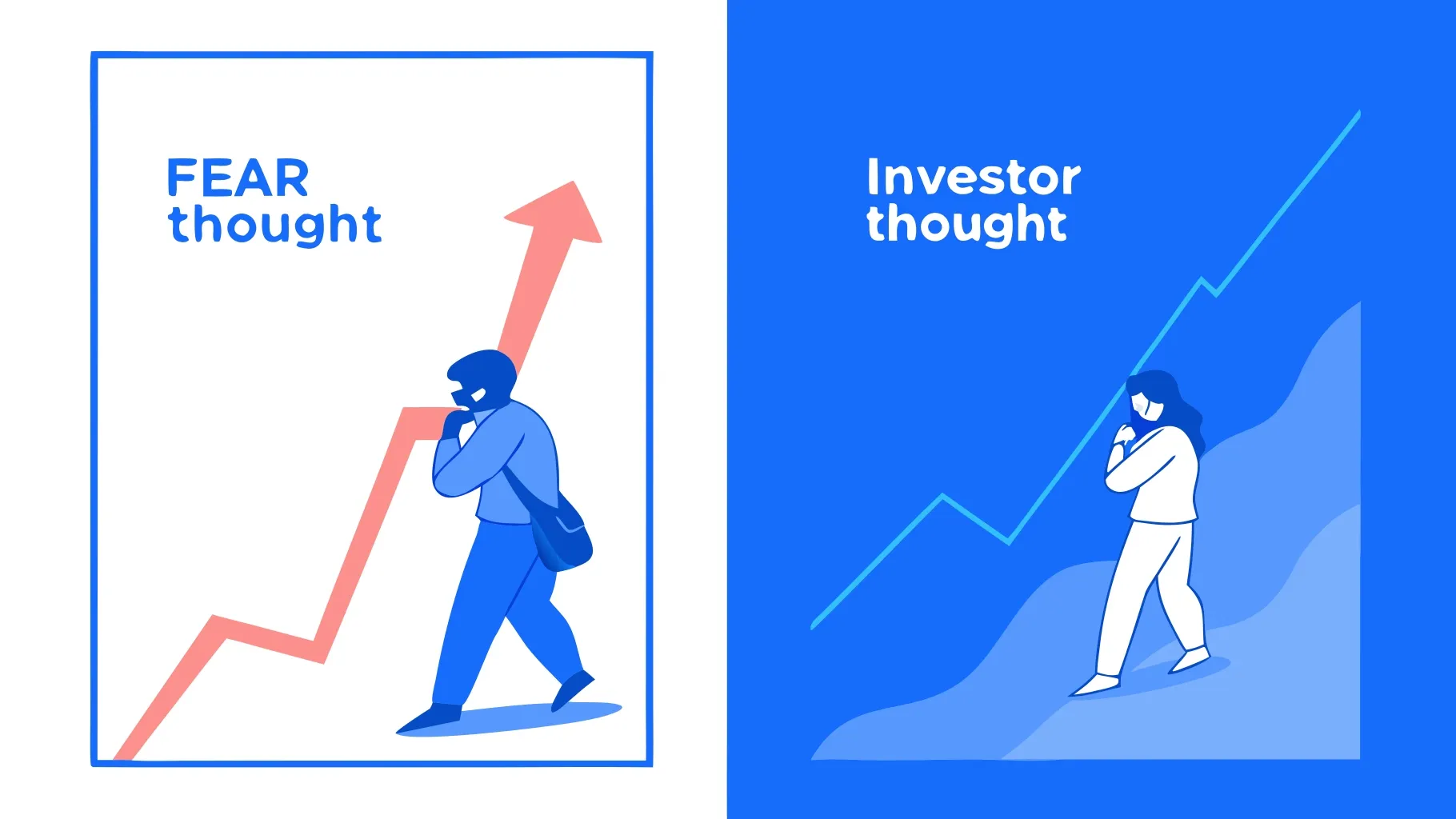
| Fear Thought | Investor Thought |
| “The market will crash right after I invest” | “Markets correct regularly. That’s normal. My 20-year timeline will include crashes and recoveries.” |
| “I don’t know enough to invest” | “I don’t need to be an expert. Passive index funds handle the complexity. I just need discipline.” |
| “What if I lose money?” | “Short-term losses happen. Long-term, markets have always recovered. My strategy accounts for this.” |
| “I’m too late to start” | “Time in market beats timing the market. Every year I wait costs me compound growth.” |
| “I should wait for the perfect moment” | “Perfect timing doesn’t exist. Consistent small investments beat perfect timing every time.” |
These aren’t positive affirmations. They’re evidence-based reframings grounded in historical data and behavioral science.
The Investor Mindset in Practice: A Simple System
You don’t need complexity. You need one system executed consistently:
Step 1: Define Your Investment Goal
What are you building for? Retirement? Home down payment? Financial freedom? Give it a specific timeline.
Step 2: Choose Your Investment Vehicle
For most people, a low-cost index fund in a retirement account (401k, IRA, Roth IRA) is perfect. You get diversification, low fees, and tax advantages.
Step 3: Set Up Dollar-Cost Averaging
Decide on an amount you can invest monthly—even $50 counts—and automate it. Set it up through your bank or brokerage so it happens without you thinking about it.
Step 4: Ignore the Noise
Don’t check your portfolio daily. Don’t follow market news obsessively. Don’t panic-sell during corrections. Your predetermined system is doing the work.
Step 5: Review Annually
Once per year, check that your allocation still matches your risk tolerance and timeline. Rebalance if needed. Then return to ignoring the noise.
That’s it. This simple system, maintained consistently for 20+ years, builds wealth more effectively than 99% of complex strategies.
Overcoming Generational Money Trauma
If you grew up watching financial instability or heard messages that investing is dangerous, your fear isn’t irrational—it’s inherited.
The investor mindset doesn’t deny your history. It works alongside it:
- Start smaller. If $500/month feels terrifying, start with $50. Your brain will adjust.
- Use automation. If you can’t see the money leave, it doesn’t feel as scary.
- Educate strategically. Not endless research (that’s procrastination), but enough to understand that passive index investing is genuinely lower-risk than staying in cash during inflation.
- Find community. Many others share your fear. Seeing people who looked like you succeed at investing helps rewire the “investing is dangerous” belief.
Your fear is valid. But evidence suggests that not investing is riskier than investing consistently in diversified index funds.
Your One Thing Today

If you’ve been waiting to invest, make one micro-decision:
Choose one investment vehicle (an index fund, ETF, or retirement account) and research it for 30 minutes. No more. You’re not trying to become an expert. You’re just removing the first barrier—uncertainty about where to start.
Then, commit to one automatic monthly investment—no matter how small—starting next month. $25. $50. $100. The amount doesn’t matter. The consistency does.
You don’t need perfect knowledge or perfect timing. You need discipline and time.
The Real Investor Mindset
The investor mindset isn’t about being fearless. It’s about being afraid and doing it anyway, because you understand that:
- Markets fluctuate, but long-term trends are up
- Perfect timing doesn’t exist, but consistent investing does
- Your emotions will fight you, but automated systems bypass emotion
- You don’t need to be an expert, just disciplined
- Time in the market beats timing the market, every single time
That’s not luck. That’s not genius. That’s the mindset that builds generational wealth.
Your fear kept you safe at one point. But if it’s keeping you from investing, it’s now the biggest threat to your financial future. The investor mindset doesn’t eliminate the fear. It makes the fear irrelevant.
And that’s when the compounding actually begins.